
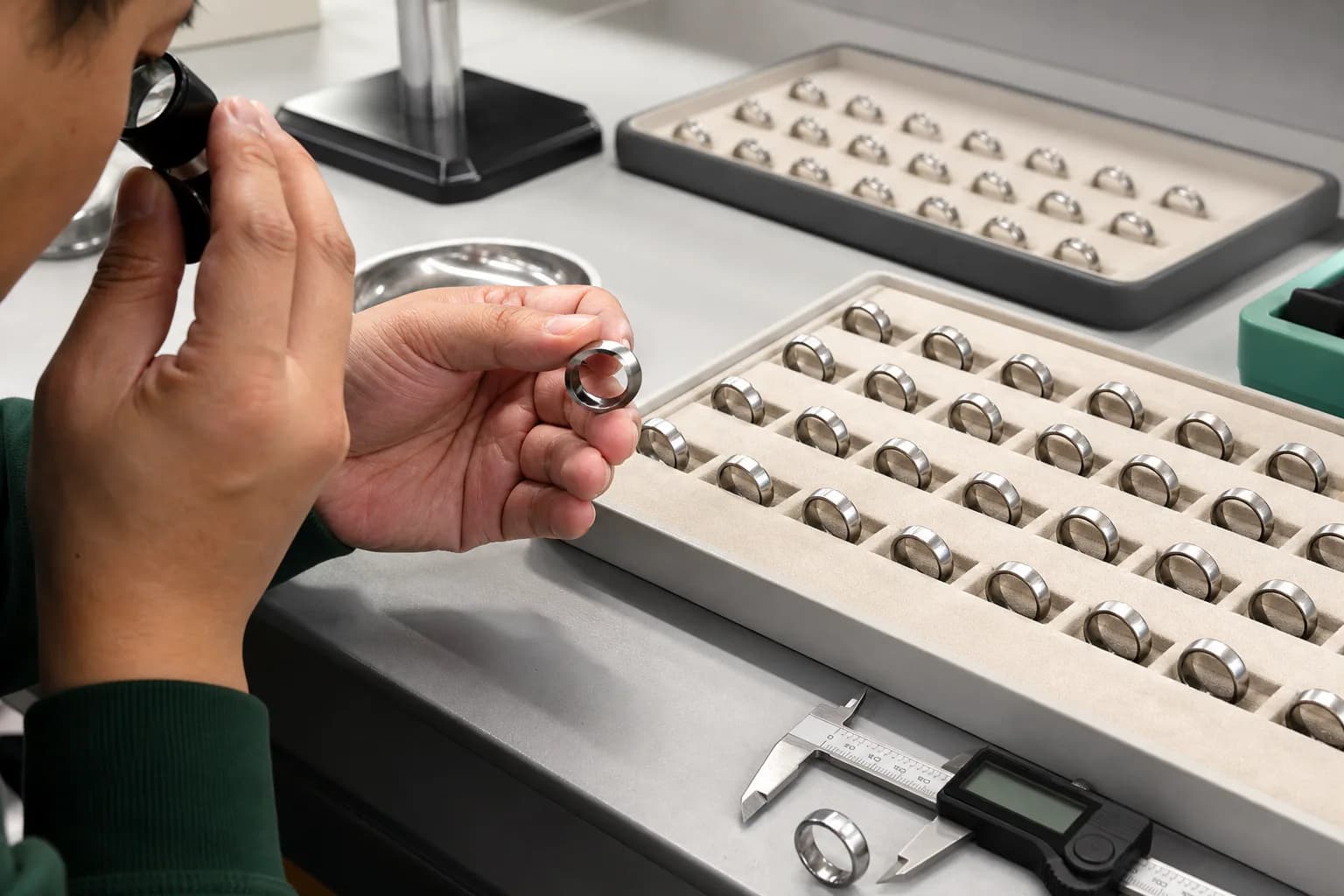
Introduction
A pre-shipment inspection cannot improve rings that have already been made, but it can stop avoidable defects, size errors and packing mistakes from becoming an expensive international delivery. For wholesale stainless steel rings, the inspection should verify more than appearance. It should connect the approved sample, purchase specification, material records, dimensions, moving functions, packaging and shipment quantities.
The short answer is: define defects and acceptance rules before production, inspect a representative sample from the completed order, test the features that matter to customers, and issue a report that supports a clear release or corrective decision. A generic checklist copied after the goods are packed is not enough.
This guide provides a practical framework for importers, jewelry brands and retailers buying 316L stainless steel rings, spinner rings, gold stainless steel rings or black stainless steel rings.
What pre-shipment inspection can—and cannot—prove
A pre-shipment inspection, or PSI, is a final verification activity performed when production is substantially complete and goods are packed or ready for packing. It can verify sampled units, quantities, visible workmanship, dimensions, function, packaging and order conformity.
It cannot by itself prove every unit is perfect. It also cannot replace material controls, laboratory testing or in-process quality checks. If a spinner track was machined incorrectly across the entire lot, final inspection may reveal the problem; it cannot economically repair it. If alloy identity matters, the supply chain needs appropriate documentation or testing before the last day.
Use PSI as one layer in a quality plan:
- Clear specification and defect definitions
- Supplier and process review
- Sample and size-set approval
- In-process controls
- Required laboratory or compliance testing
- Pre-shipment inspection
- Receiving inspection and performance feedback
The earlier a problem is detected, the more options the buyer and factory usually have.
Start with the approved product specification
An inspector can only compare the shipment with something defined. The inspection pack should include:
- Purchase order and SKU breakdown
- Approved sample or controlled images
- Drawings and critical dimensions
- Base material and coating specification
- Size system and tolerance
- Color and finish reference
- Spinner or moving-function requirement
- Stone, enamel and logo details
- Packaging, barcode and carton instructions
- Required reports and destination-market documents
- Defect classification and acceptance plan
Avoid subjective instructions such as “premium polishing” or “smooth spinner.” Translate them into observable checks: no sharp edge under normal handling, rotation without seizure, no visible burr at a stated viewing condition, and comparison with the approved sample.
If an item differs intentionally from the sample, document the approved change before inspection. Otherwise the inspector may reject a change the buyer accepted verbally, or overlook a change that was never authorized.
AQL: what wholesale buyers need to understand
AQL refers to acceptance quality limit in a sampling system. ISO 2859-1:2026 defines AQL-indexed sampling schemes for lot-by-lot inspection. The standard helps determine sample sizes and acceptance/rejection thresholds instead of inspecting an arbitrary handful of products.
AQL does not mean the buyer agrees that a stated percentage of every shipment may be defective. It is part of a statistical acceptance system with producer and consumer risks. The selected inspection level, lot size, sampling plan and defect limits work together.
Many consumer-goods inspections classify defects as critical, major and minor, but the definitions must be product-specific.
Example defect logic for rings
- Critical: condition presenting an unacceptable safety or regulatory risk; wrong restricted material where verified; dangerous sharp edge.
- Major: non-functioning spinner, loose stone, wrong size label, material or color that makes the item unsaleable, severe coating defect.
- Minor: small cosmetic deviation that does not materially affect function or saleability under the agreed viewing condition.
These are examples, not universal legal classifications. The buyer should approve the defect list before production. A feature that is minor for one channel can be major for another. A tiny mark hidden inside a promotional ring may be treated differently from the same mark on a premium polished signet face.
Inspection readiness before the inspector arrives
The lot should be sufficiently complete and accessible. Cartons must be identifiable, and the inspector must be able to draw samples across the shipment rather than receiving a supplier-selected display set.
Confirm in advance:
- Production completion percentage required by the inspection company
- Packing completion and whether cartons can be reopened
- Shipment lot and batch identification
- Location of all SKUs, sizes and colors
- Availability of approved samples and gauges
- Tests that can be performed on site
- Destructive-test sample allowance
- Time for corrective action and reinspection
If the shipping deadline leaves no time for a failed result, the inspection is being treated as paperwork rather than risk control.
Step 1: quantity, assortment and carton checks
Start with the order structure. Compare carton count, SKU, color, size and quantity with the purchase order and packing list. Check carton marks, gross/net weight where specified, dimensions and closure.
For mixed-size rings, verify that product, pouch label, barcode and carton data agree. Open cartons from different positions. A correct total count can still hide a serious assortment error, such as too many size 6 rings and too few size 8 rings.
Check retail packaging for scuffs, moisture, odor, deformation and print defects. Rings should not rub against each other or against hard accessories during transport. Black and mirror-polished finishes need particularly clean handling.
Step 2: identity and documentation checks
Confirm that the sampled product matches the ordered design, material declaration, finish and branding. A marking such as “316L” is not proof of alloy identity by itself. Review the documents or test reports required by the purchase agreement and make sure they identify the relevant product or batch.
For sales into the European Union, nickel release is a relevant regulatory consideration for finger rings intended for direct and prolonged skin contact. Current REACH text sets a nickel-release limit for such articles. Buyers should obtain market-specific compliance advice and agree appropriate testing; a general “hypoallergenic” statement is not a substitute.
Check document dates, product references, laboratory identity and whether results apply to the finished construction. A report for bare steel does not necessarily support every claim about a coated, assembled ring.
Step 3: workmanship and finish inspection
Inspect each sampled ring under consistent lighting and viewing conditions. Rotate it to examine the exterior, interior, edges, underside, logo, grooves and stone settings.
Look for:
- Scratches, dents, pits and polishing lines
- Burrs or sharp edges
- Incomplete or uneven coating
- Gold-tone variation
- Black-finish dust, fingerprints or bright wear lines
- Enamel overflow, gaps or contamination
- Misaligned stones or motifs
- Adhesive residue
- Poor engraving or incorrect logo position
- Deformation and asymmetry
Compare defects with the approved classification rather than deciding by mood. Photograph representative failures with scale and location. If one defect repeats, investigate whether it is concentrated in a size, cavity, coating batch or workstation.
Step 4: dimensions, weight and ring-size accuracy
Measure the characteristics defined as critical: ring size, width, thickness, feature dimensions and weight where controlled. Use calibrated or verified equipment suitable for the tolerance.
ISO 8653:2016 provides a method for ring-size measurement using a ring stick with defined characteristics. For inspection, the buyer and supplier should still agree the practical tool, reading method and tolerance.
Measure across sizes, not only the most common one. Tooling or finishing variation may affect the smallest and largest sizes differently. For comfort-fit or unusual interiors, include measurement instructions in the inspection file.
Record actual values. A table of results provides more insight than a row of check marks and helps detect drift between shipments.
Step 5: spinner and moving-function tests
Spinner rings need functional inspection because a ring can look correct while the movement feels rough, noisy or blocked.
Check:
- Rotation through the full path
- Intended resistance compared with approved sample
- Wobble and lateral play
- Scraping or coating contact
- Pinching points
- Loose components
- Sound level where relevant
- Function after repeated operation
The requirement should describe the intended experience. “Spins” is too broad. A fashion spinner may be designed for slow, controlled thumb movement rather than long free rotation.
Use a repeatable internal method for comparison, but do not invent a universal cycle count and present it as an industry standard. If cycle testing is part of the contract, define the fixture, load, speed, cycles and pass criteria.
Step 6: stones, enamel and decorative components
Inspect stone alignment, security, chips, missing pieces and color consistency. For enamel, check fill boundaries, bubbles, cracks, contamination and color. For glued elements, review residue and conduct the agreed attachment check.
Do not use an improvised pull or impact test without considering the design. A method severe enough to damage a conforming decorative product creates misleading failures. Select product-appropriate tests during development and document them in the inspection instruction.
After testing, recheck finish around settings and moving parts. Assembly tools may mark PVD surfaces, and repeated spinner movement may reveal contact that was not visible initially.
Step 7: packaging and shipment simulation
Packaging should protect the ring and preserve SKU identity. Verify pouch, card, box, insert, care instructions, barcode, country-of-origin information and carton arrangement against the approved artwork and packing specification.
Where the contract requires it, perform the agreed carton or packaging checks. These may include measurements, weight verification and a defined drop or handling simulation. The purpose is not to create a dramatic test video; it is to determine whether the actual export pack protects the product under the agreed condition.
After any simulation, reopen representative retail packs and inspect the rings for rubbing, stone damage, spinner obstruction or coating marks.
Step 8: report, disposition and corrective action
The report should state:
- Order, factory, product and inspection date
- Lot size and sampling basis
- SKU and carton sampling distribution
- Defect counts by classification
- Measurement and test results
- Quantity and packaging findings
- Photographs
- Overall result under the agreed plan
- Open issues or deviations
A report supports the release decision; it does not automatically make that decision for the brand. If the result fails, evaluate severity, scope and root cause. Options may include sorting, rework, replacement, concession, reinspection or shipment hold.
Do not accept a vague promise to “improve next time” for a current failed lot. Define what will be corrected, how units will be segregated and what evidence will support reinspection.
Common inspection mistakes
Inspecting only appearance
A spinner ring can have a beautiful finish and poor movement. Size, function and assortment require equal attention.
Sampling from one carton
Defects and mix-ups may be batch- or carton-specific. Samples should represent the shipment structure.
Using an undefined golden sample
If neither side can identify the approved revision, comparison becomes subjective. Label and retain the controlled sample.
Confusing a supplier declaration with a test report
Both can have roles, but they provide different evidence. Define which documents are required for the product and market.
Choosing AQL after defects are found
Acceptance rules should be agreed before production. Changing them after inspection undermines a fair decision process.
Shipping before the report is reviewed
Build inspection and decision time into the schedule. A report received after goods leave the factory has much less value.
A reusable inspection checklist
Order and quantity
- [ ] PO, SKU, color and size breakdown available
- [ ] Carton count and packing list verified
- [ ] Samples drawn across cartons and variants
Product identity
- [ ] Design matches approved revision
- [ ] Material and finish documents reviewed
- [ ] Logo, markings and color correct
Workmanship
- [ ] No unacceptable sharp edges or burrs
- [ ] Polish, PVD, enamel and stones meet standard
- [ ] Interior and hard-to-see areas inspected
Measurement and function
- [ ] Ring sizes measured and recorded
- [ ] Critical dimensions within tolerance
- [ ] Spinner movement compared with approved sample
- [ ] Decorative components checked
Packaging
- [ ] Product and size labels agree
- [ ] Individual protection prevents rubbing
- [ ] Barcode, care card and carton marks correct
- [ ] Agreed shipment simulation completed
Reporting
- [ ] Defects classified and photographed
- [ ] Sample distribution documented
- [ ] Result calculated under agreed plan
- [ ] Corrective actions and release decision recorded
Frequently Asked Questions
What AQL should be used for stainless steel rings?
There is no single mandatory value for every order. Choose the sampling plan and defect limits based on product risk, customer expectations, supplier history and contract requirements. Critical defects usually require the strictest treatment.
Does an inspection prove the rings are 316L?
Visual inspection cannot prove alloy composition. Material verification requires appropriate supply-chain documentation or testing. An internal “316L” engraving is not independent evidence.
When should pre-shipment inspection happen?
When production is substantially complete and enough goods are packed to verify the shipment, while still leaving time for corrective action. Agree readiness criteria with the inspection provider.
Should every spinner ring be function-tested?
Factories should use suitable process controls, while final PSI normally uses an agreed sampling plan unless the contract requires 100% screening. High-risk or repeated failures may justify tighter control.
Can the supplier perform the inspection?
Supplier QC is essential, but buyers may also use their own team or an independent inspection company. The choice depends on risk, relationship, order value and the evidence required.
What happens if inspection fails?
Hold release, determine scope and root cause, agree sorting/rework/replacement, and reinspect where needed. The contract should define responsibilities and disposition options.
Conclusion
Pre-shipment inspection is most effective when it is the final confirmation of a quality system that started with a clear brief. For wholesale stainless steel rings, the inspection must connect material records, ring-size accuracy, finish, spinner function, decorative security, packaging and quantity.
Define acceptance rules early, inspect a representative sample, record measurements and leave time to act on the result. This approach does not promise zero risk. It creates visible evidence and better decisions before an international shipment becomes difficult to correct.
Sources and editorial note
- ISO 2859-1:2026 — AQL-indexed sampling for lot-by-lot inspection
- ISO 8653:2016 — Jewellery ring-size measurement and designation
- EU REACH consolidated text — nickel release for articles including finger rings
This article is a purchasing and quality-planning guide, not legal advice. Inspection methods and compliance requirements should be selected for the actual product and destination market.