
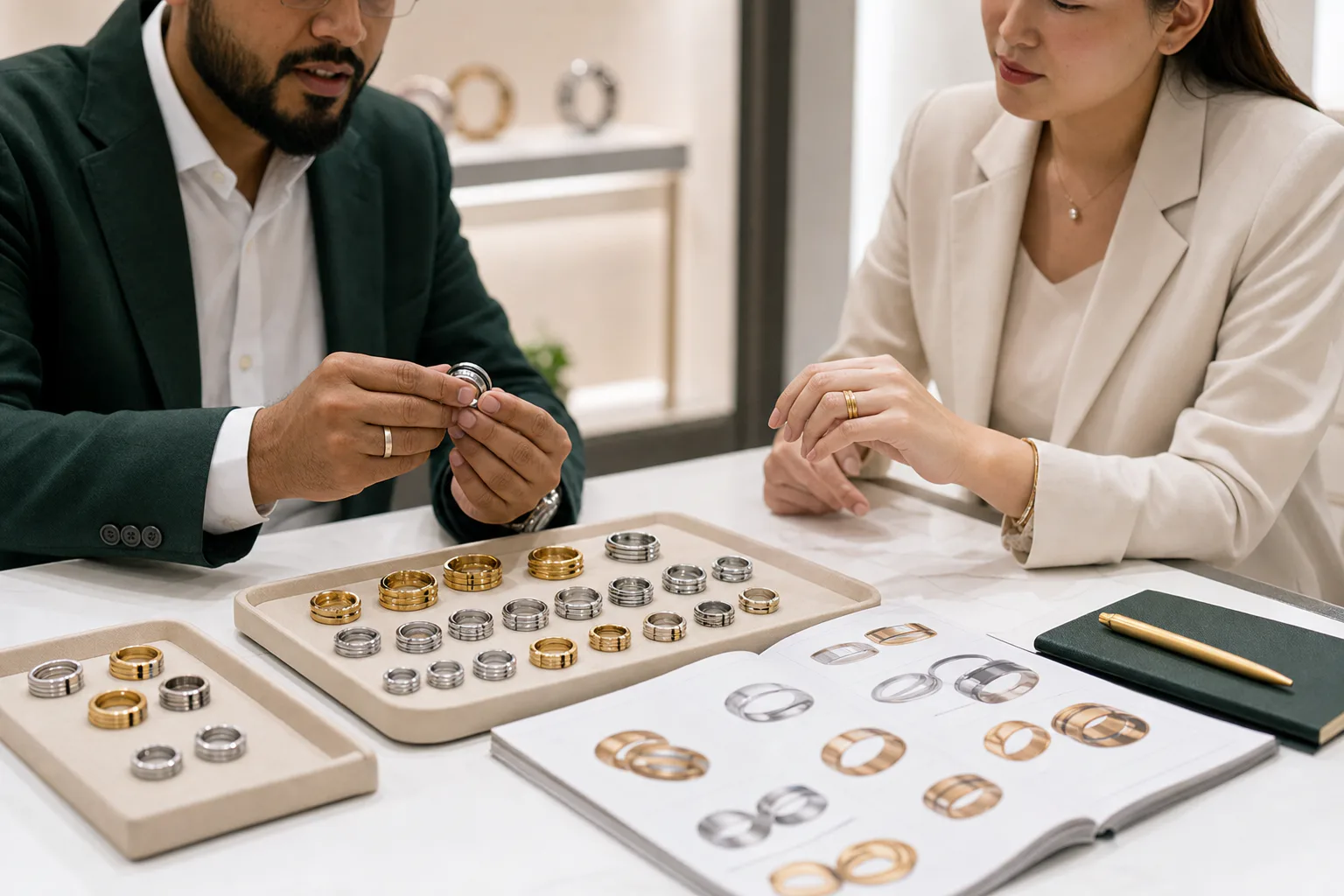
Start with the market, not the factory catalog
Define the customer, price position and retail channel before selecting a mechanism. A women’s fashion collection may prioritize slim profiles, quiet motion and jewelry-led motifs. A men’s line may support wider bands and stronger tactile feedback. Subscription boxes need predictable landed cost and packaging speed; premium boutiques may accept slower development for differentiated details.
Map the assortment rather than sourcing isolated pieces. A coherent launch might combine one hero spinner, two motif variations and a simpler entry design in shared plating colors. Reusing structures across styles can reduce development risk while still creating visible variety through enamel, stones, texture and surface finish.
Write a quote-ready product brief
A strong brief includes ring category, target dimensions, size range, base alloy, finish, moving action, decorative process, logo treatment, quantity by variant, packaging, compliance destination and required delivery date. Label reference images as inspiration or exact requirements. If a detail is critical, add a measurement or acceptance description.
Ask suppliers to separate tooling, sampling, unit price, packaging and freight assumptions. Confirm whether the quotation uses 316L throughout or mixes materials in moving or decorative components. Record what is included in the price so later comparison remains meaningful.
- Target market and retail price band
- Size range and quantity by size/color
- Base material and coating system
- Movement type and desired tactile feel
- Logo, packaging and labeling
- Destination compliance and test needs
OEM, ODM and private label are different paths
Private label usually applies your branding to an existing or lightly modified design. ODM starts from a supplier-developed concept that can be adapted. OEM commonly means manufacturing to the buyer’s specification. In practice, suppliers use these terms differently, so define ownership, exclusivity, tooling and allowed modifications in writing.
The lowest-risk path for a first collection is often a controlled modification of a proven structure. A fully custom spinner mechanism offers stronger differentiation but requires more engineering, prototypes and validation. Choose the route that matches commercial opportunity, budget and launch timing.
Turn the idea into a manufacturable design
Product development converts the brief into dimensions, surfaces and assembly logic. CAD can communicate form and clearances, but it cannot prove the feel of a moving ring. The engineer must consider wall thickness, edge radii, stone seats, enamel areas, polishing access and coating coverage.
Request a design review before tooling. Confirm the mechanism, logo size, engraving depth, finish boundaries and size grading. If multiple ring sizes use the same decorative pattern, determine how the motif scales or repeats. Small decisions at this stage prevent visible inconsistency later.
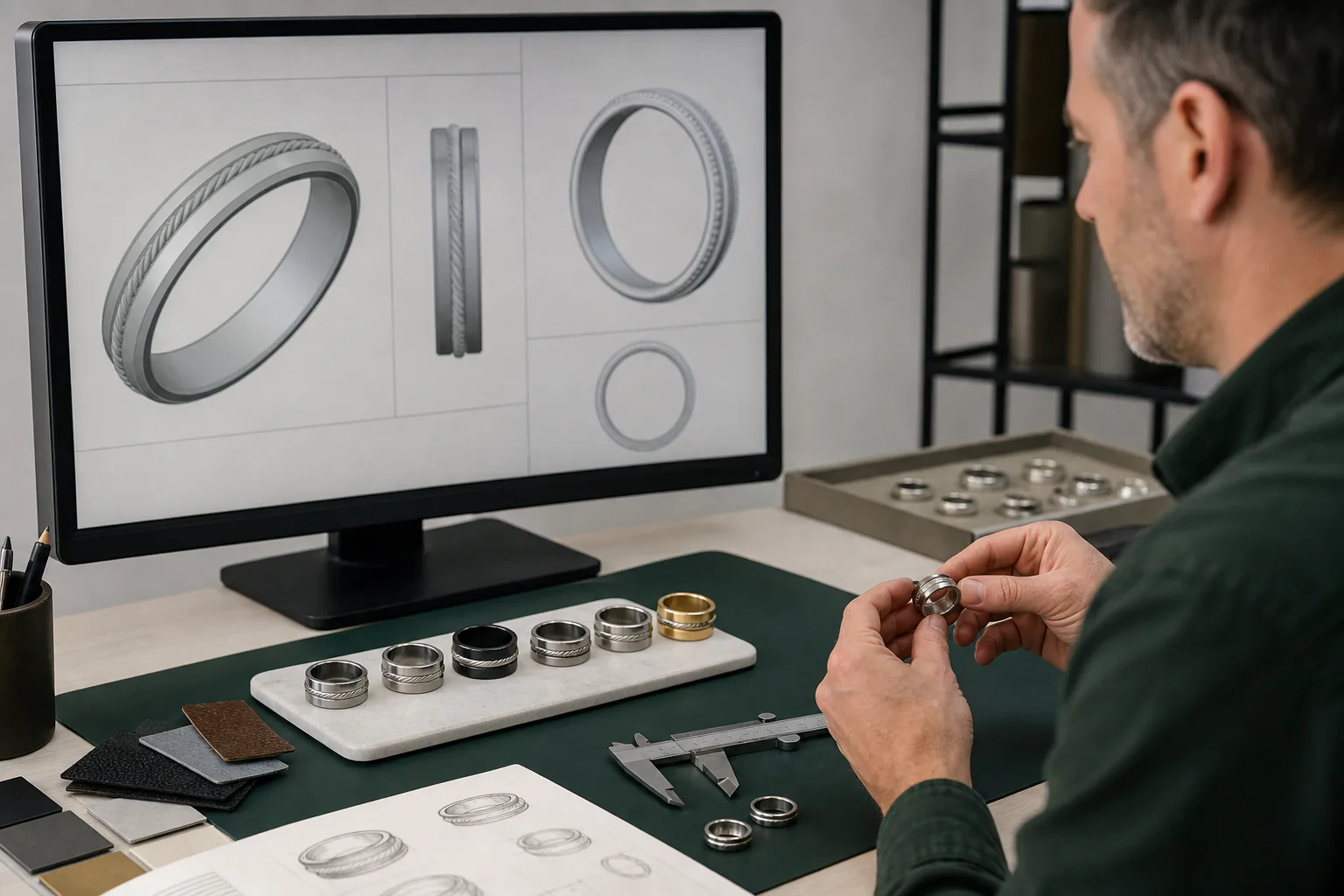
Approve samples with a written scorecard
A sample is a decision tool, not a courtesy image. Review it in person when possible. Measure size and width, check comfort edges, operate the spinner repeatedly, inspect under neutral light and compare color against an approved reference. Photograph and number every requested revision.
Approve a final golden sample and keep one with both buyer and supplier. Record weight, dimensions, plating color, packaging and functional notes. Production should match this agreed reference within stated tolerances rather than a memory of what “premium” looked like.
Build quality into production
Quality control begins with incoming material and continues through forming, machining, polishing, cleaning, coating, assembly and packing. For spinner rings, process checks should catch rough tracks or gap variation before final plating makes rework expensive. Sampling plans should reflect order size and risk.
Define critical, major and minor defects. Sharp edges, incorrect material, loose stones and non-functioning movement may be critical or major depending on the product. Small cosmetic marks need an agreed viewing distance and lighting condition. Clear definitions reduce argument and speed corrective action.
Packaging and export readiness
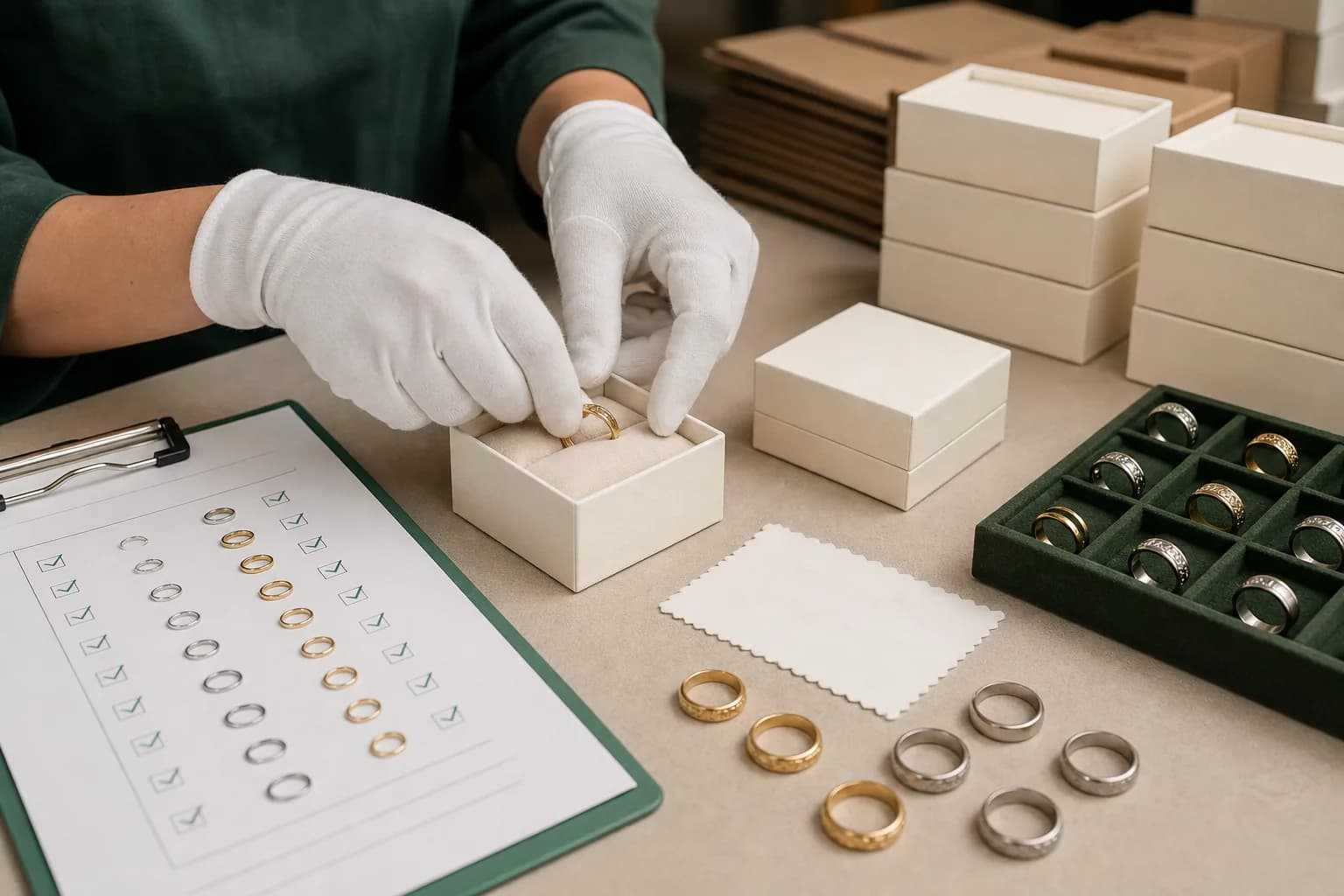
Packaging protects the finish and carries the brand promise. Specify box dimensions, insert material, pouch, care card, barcode, country-of-origin marking and master-carton requirements. Make sure a spinner cannot move against abrasive packaging during transport.
Before shipment, confirm quantities by SKU and size, packing list, carton marks, inspection status and document requirements. Build time for customs and final-mile variability into the launch plan. A realistic delivery plan is more valuable than an optimistic date without checkpoints.
MOQ, price and total landed cost
MOQ depends on structure, tooling, materials, color, size distribution and factory scheduling. Ask whether the minimum applies per design, color or size. A low unit quote may exclude tooling, testing, packaging, payment fees, inspection and freight. Compare total landed scenarios at realistic quantities.
Do not optimize only for the first order. Reorder lead time, component continuity, color matching and documentation determine whether the collection can scale. A slightly higher initial price may be justified when the supplier maintains stable records and can reproduce the approved result.
Supplier evaluation questions
Ask who owns product development, how samples are controlled, which operations are internal, how material is verified, how coating batches are managed and what happens when inspection fails. Request examples of records, not only promises. Communication quality during sampling often predicts production communication.
For a new supplier, begin with a focused pilot order. Review sell-through, returns, finish feedback and operational performance before expanding. Share structured feedback so the next batch can improve without changing approved features unintentionally.
- Can you document the material and coating specification?
- How is the approved sample controlled during production?
- Which tests are available and which laboratory performs them?
- How are defects classified and corrected?
- Can packaging, barcodes and size assortments be packed by SKU?
- What records support an identical reorder?
Frequently asked questions
How long does custom development take? It depends on tooling, revisions, coatings and testing. Build a schedule around decision gates rather than a single promised date.
Should I request 316L? It is a common premium choice for stainless steel rings, but verify the material and decide requirements based on target market, design and compliance obligations.
Can one sample represent bulk quality? It defines the target, while production inspection verifies consistency. Both are required.
What information gets the fastest useful quotation? Quantity by variant, target material, sizes, finish, movement, customization, packaging, destination and deadline.
Sources and editorial note
This guide combines product-development experience with publicly available references. It is educational content, not medical, legal or compliance advice. Requirements vary by market and product.