
The short answer
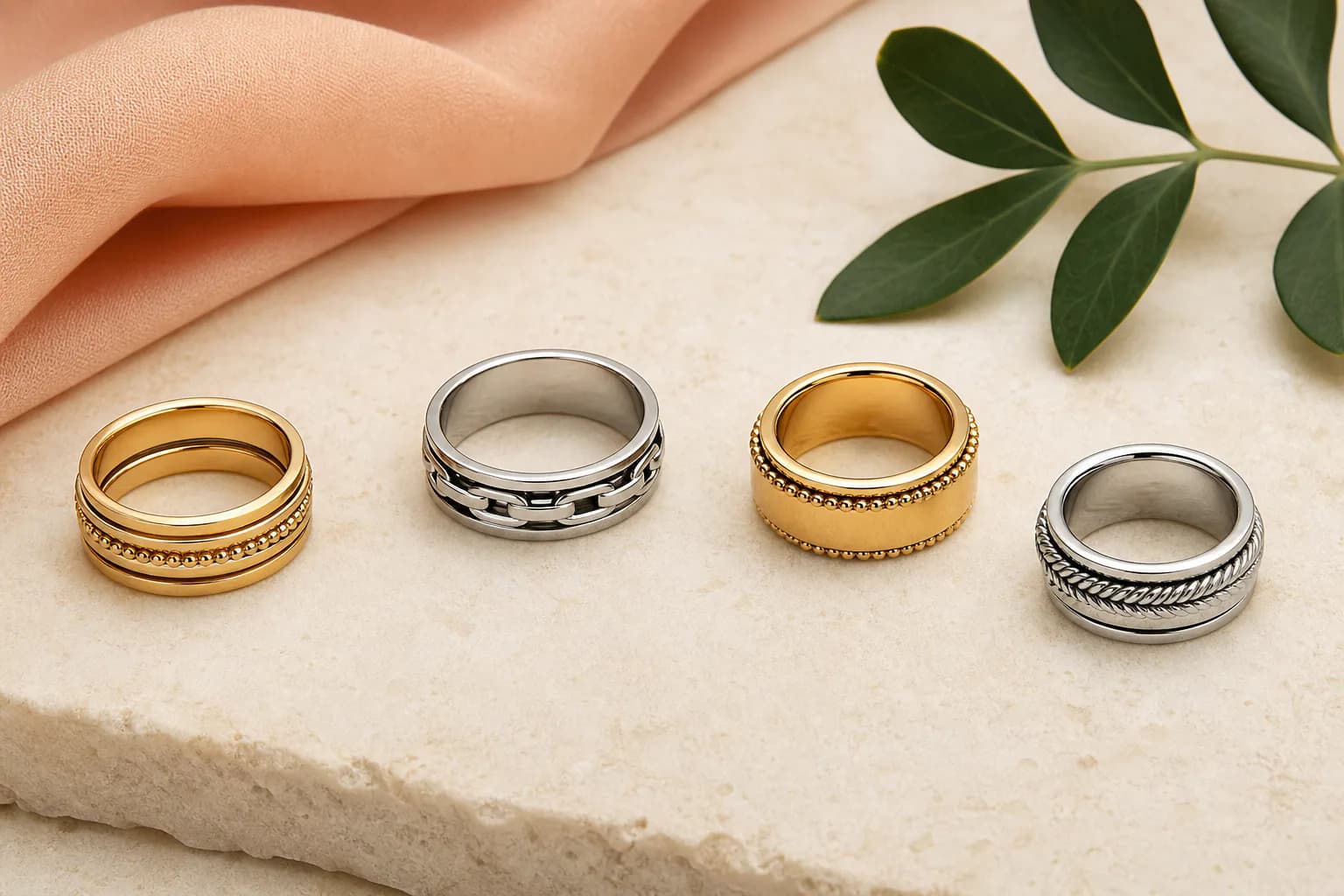
A spinner ring is defined by construction: an outer band or moving element rotates around a stable inner band. A fidget ring is the broader category for any wearable ring with a tactile action such as spinning, rolling, sliding, clicking or turning. A worry ring usually describes a repetitive, quiet movement associated with self-soothing traditions. “Anxiety ring” is a popular search and retail phrase, not a medical device classification.
One product may fit all four descriptions. A two-band stainless steel ring can technically be a spinner ring, functionally be a fidget ring, culturally be called a worry ring and commercially appear in an anxiety-ring collection. The responsible distinction is to describe what the ring does without promising that it diagnoses, treats or cures a health condition.
How a spinner ring actually works
Most spinner rings use a comfort-fit inner band as the part that touches the finger. A second band sits in a shallow track or is mechanically retained around it. The tolerances must be loose enough to move but controlled enough to avoid excessive wobble, pinching or a rattling feel. Surface finishing matters because microscopic burrs or uneven plating can create friction.
There is no single ideal spin time. Some customers prefer a free, fluid rotation; others want a slower, more deliberate movement that can be controlled under a table or during a meeting. For a retail buyer, the useful specification is not “spins fast,” but the intended tactile character: silent or audible, free-spinning or resistant, continuous or indexed.
- Rotating outer band: classic spinner construction
- Loose rolling beads: small repeated movement
- Chain or linked detail: flexible tactile motion
- Turnable flower, star or disc: localized rotating feature
What makes a ring a fidget ring?
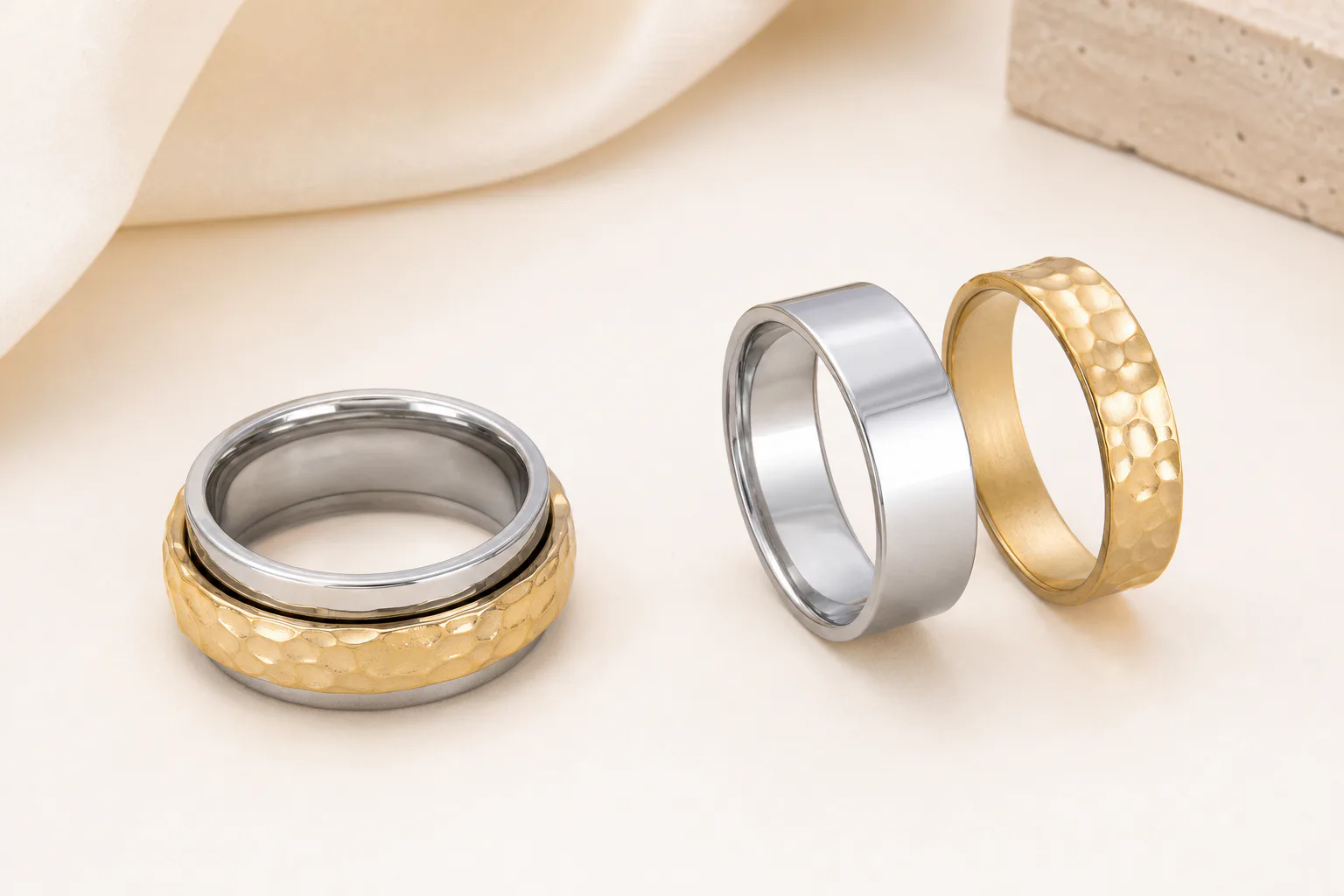
“Fidget ring” describes the job the jewelry performs. It gives the wearer a small, repeatable action without carrying a separate object. The most wearable designs look like ordinary jewelry first. This discretion is repeatedly mentioned in real user discussions: people value a ring that can be used quietly in public and still receive compliments as jewelry.
The experience depends on more than the visible feature. Width, weight, edge radius, ring size and the gap between moving components change how the action feels. A delicate floral spinner may suit a customer seeking subtle movement, while a wider chain spinner may deliver stronger tactile feedback. Product copy should explain the action in plain language and show it in video whenever possible.
Worry ring and meditation ring: names shaped by tradition
Worry rings and meditation rings are older, more interpretive terms. They often refer to bands that invite rhythmic thumb movement. The emphasis is ritual and attention rather than speed. Some designs use several interlocking bands; others use a single rotating band with texture or engraved motifs.
Retailers should avoid presenting a cultural label as a scientific claim. A customer may find repetitive movement personally calming, but experiences vary. The most trustworthy language is experiential: “offers a smooth, discreet motion,” “designed for tactile moments,” or “a jewelry-led alternative to a separate fidget object.”
Is an anxiety ring proven to reduce anxiety?
A ring can provide an accessible object for repetitive movement, but that does not make it a treatment. Research on fidget tools is mixed and depends on the person, setting and outcome being measured. Medical or therapeutic claims require evidence far beyond a jewelry product test. A seller should never guarantee relief, improved concentration or a clinical result.
A safer and more useful approach is to separate observable product facts from personal experience. Observable facts include movement type, sound, material, dimensions and finish. Personal experience can be described as customer-reported preference, not universal effect. Anyone experiencing persistent anxiety should seek support from a qualified health professional.

How to choose the right design
Start with motion. If you enjoy continuous rotation, choose a full outer-band spinner. If you prefer small directional actions, look for beads, a short chain or a turnable motif. Next consider discretion: a polished floral or mother-of-pearl ring reads as fashion jewelry, while a heavier mechanical band makes the function more visible.
Check comfort and care. A smooth interior, rounded edges and accurate sizing matter for daily wear. People with known metal sensitivities should review the complete material declaration and consult a clinician where appropriate; “stainless steel” alone does not describe every alloy, coating or component. Remove a ring if it causes irritation, swelling or discomfort.
- Motion: free spin, controlled turn, roll or slide
- Sound: silent, soft or intentionally tactile
- Profile: slim jewelry look or bold mechanical band
- Material: documented base metal and finish
- Fit: comfort interior with enough clearance for movement
What wholesale buyers should specify
For private-label sourcing, a reference image is not enough. Define base material, ring width, size range, moving structure, intended resistance, finish, stone or enamel details, logo location, packaging and test expectations. Ask for a functional sample before approving production because movement cannot be judged accurately from a render.
A useful sample review checks smoothness across several minutes of use, alignment after repeated rotation, sound, sharp edges, coating consistency and size accuracy. Approve a physical golden sample and record its weight and dimensions. This converts a subjective idea—“a satisfying spinner”—into a repeatable production standard.
Frequently asked questions
Are spinner rings only for women? No. The mechanism works across women’s, men’s and unisex designs. Style, width, size range and merchandising determine the audience.
Can a spinner ring pinch skin? Poorly controlled gaps or sharp edges can be uncomfortable. A well-developed sample should be reviewed in the intended size range before bulk production.
Do fidget rings make noise? Some are nearly silent; chains, loose beads and wider metal-on-metal structures may produce sound. Product descriptions should state this clearly.
Which name is best for SEO? Use the term that matches the page’s search intent, then explain the synonyms naturally. A comparison guide can target all four without stuffing them into every heading.
Sources and editorial note
This guide combines product-development experience with publicly available references. It is educational content, not medical, legal or compliance advice. Requirements vary by market and product.